Kronos
Smilla's Sense of SnowThe Kronos is a four-thousand-ton coaster transformed into a powerful, ice-strengthened ship for a secret voyage toward Greenland. Its conspicuous engineering is matched by concealed contracts, restricted movement, and a specially rebuilt forward tank: the vessel carries Smilla Qaavigaaq Jaspersen toward the expedition while embodying the industrial system that keeps its real cargo and destination obscure.
Acquisition and concealed purpose
The ship enters the story through the practical difficulties of chartering a vessel without disclosing where it will go or what it will carry. Birgo Lander explains that a conventional charter contract records destination and freight, while a discreet arrangement may use a side contract to conceal those details. Because a ship bound for Greenland must meet ice-class requirements, its classification and inspection history offer additional clues for anyone trying to trace the transaction. When Smilla and Lander check the name Kronos against Lloyd’s Register, they find five ships bearing it; the two general-cargo vessels, based in Piraeus and Panama, are the candidates that matter.
Captain Sigmund Lukas recounts how the owners approached him about sailing north of Godthåb in March. He warned them about the pack ice, the waters known as the Iceberg Cemetery, and the dangerous succession of drift ice, calving icebergs, and ice avalanches reaching the sea from the glaciers. His warnings did not change their plan. The ship was bought, refitted, and brought to South Harbor, where Lukas hired ten men as its crew.
The secrecy is built into the working conditions as well as the paperwork. A passenger says that alcohol is prohibited, the crew stick together, passengers remain unseen, and even Lukas does not know the destination. The ship’s own features make the northbound purpose legible despite this enforced silence: it has a double hull, icebreaker cables running along its length, unusually thick forward plating, and an ice cutter above the propeller. Jakkelsen estimates that the engine can drive it through the ice at sixteen to eighteen knots; elsewhere he gives a cruising speed of eighteen to nineteen knots.
Machinery, deck, and hidden spaces
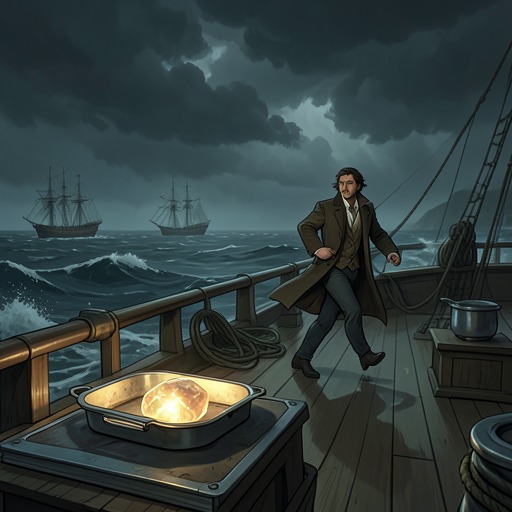
The bridge overlooks a conspicuously orderly working deck. Under a single deck lamp, the ship’s two sixty-foot masts carry heavy cargo booms, with four cargo winches at each mast; a control box sits by the raised foredeck. A covered rectangular object between the masts may be the LMC, a surplus naval landing vessel. The foredeck holds a large anchor winch and a four-section cargo-hold hatch, while floodlights, fire hydrants, foam extinguishers, and rescue equipment line the deck. The arrangement looks prepared for work, but the blue-clad figures securing the covered object disappear, the deck light goes out, and the ship’s visible face returns to darkness.
Below deck, the machinery is both exact and difficult for Smilla to comprehend. Jakkelsen describes a nine-cylinder Burmeister and Wain engine, its cylinders eighteen inches in diameter with a twenty-nine-inch stroke, direct-reversible and supercharged. Though built in the 1960s, it has been renovated and fitted to the ship’s icebreaking role. Smilla observes its injection valves, fuel cocks, pipes, springs, polished steel and copper, and exhaust manifold; the engine’s impersonal motion makes it seem less like an individual machine than the operating principle of a whole system. The point is not simply that the Kronos is powerful, but that its power continues beyond the comprehension or control of the people aboard.
That engineered opacity extends into the aft spaces. Smilla uses Jakkelsen’s key to enter a section sealed off behind a bulkhead, where a former set of cabins has been remade as a storeroom. Inside are blue two-inch nylon hawsers, polypropylene rope, and eight sets of quarter-inch Kermantel double rope in fluorescent alpine safety colors. The ship offers apparently ordinary storage while concealing spaces and equipment that make its actual mission harder to read.
A voyage made legible in fragments
The ship’s route emerges not through a clear briefing but through physical clues. When Lukas points to his chart, it shows South Greenland, overlaid with a transparent facsimile marking ice concentrations, visibility, and iceberg positions. The plotted course runs north along the coast, rounds Cape Thorvaldsen, then turns north-northwest before stopping in the open ocean near Vestland. Lukas says this is all he knows; command itself has been reduced to following a course whose purpose remains withheld from him.
The departure from the Greenland Star is similarly stripped of ceremony. There is no blast of the horn, and Smilla notices the ship is moving only through a change in the hull’s motion. At eighteen knots, it can cover four hundred to four hundred and fifty nautical miles in a day, making a twelve-hour passage to the suspected destination plausible. From the timing and course, Smilla concludes that the Kronos may be heading for the Barren Glacier on Gela Alta.
The ship’s cargo handling provides another view of how this secrecy works. During a timed operation, orders are given from the enclosed crow’s nest; after a countdown, a container lies in the water fifteen feet behind the stern, held alongside by a blue hawser and kept clear of the hull with a long boathook. Inflatable strips run along its sides. The procedure turns the ship into a controlled transfer point, able to move cargo at sea without making the nature of the cargo evident to observers.
The forward hold and the expedition’s secret
Smilla rejects the easy explanation that the Kronos is transporting narcotics. A four-thousand-ton ship is disproportionate for a Greenland-bound drug shipment, she reasons, and the forward hold is unlike any ordinary cargo space she has seen. It can be sterilized with steam, and its air composition, temperature, and humidity can be regulated. Those features lead her to a different conclusion: the vessel is designed to carry something alive.
That inference sharpens when Smilla examines the rebuilt forward tank. It has sterilization capability and supplies of oxygen and compressed air, making its configuration suitable for transporting a large animal. She suspects that Tørk believes the stone the expedition plans to retrieve is alive. The ship’s specialized tank thus connects its otherwise puzzling technical features to the expedition’s actual object of interest, without resolving what that belief means or whether it is true.
The Kronos is consequently more than transport. Its double hull and reinforced bow answer the physical threat of Arctic ice; its hidden spaces and adaptable cargo systems serve a secret operation; and its restrictive routines make knowledge aboard the vessel as carefully managed as the cargo. For Smilla, the ship’s machinery and architecture yield the truth in fragments: a route on a chart, a sealed compartment, an unexplained transfer, a tank equipped for life. The vessel can carry the expedition north, but it cannot make its purpose fully visible to those it carries.